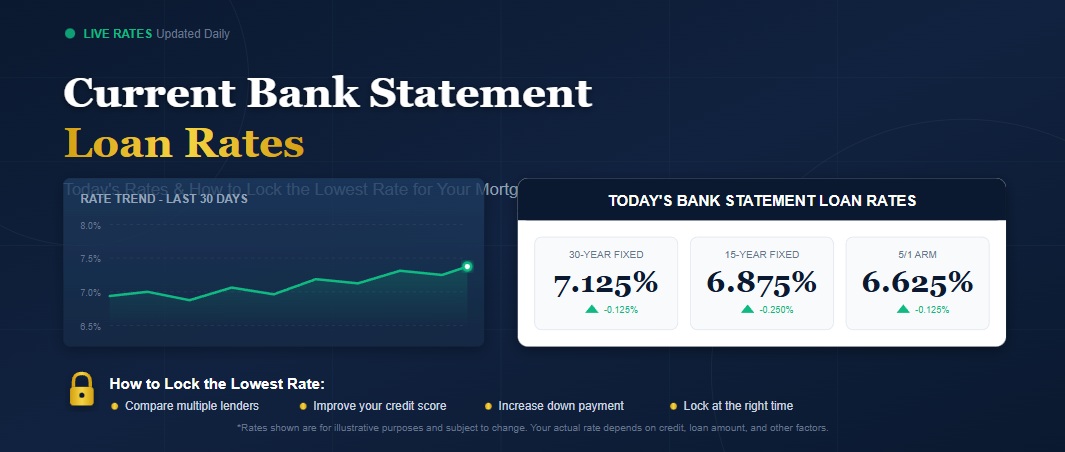
Bank statement loan rates don’t have one official national average. These mortgages are generally priced by non-QM investors, so the rate changes with the borrower’s credit, loan-to-value ratio, occupancy, property, loan size, statement method, reserves, points, and lock period. Two self-employed borrowers applying on the same day can therefore receive different pricing even when they’re buying homes at similar prices.
The broader mortgage market still provides useful context. Freddie Mac reported an average 30-year fixed conventional mortgage rate of 7.03% for the week of September 24, 2026, while the Federal Reserve reported a 10-year Treasury yield of 5.18% on September 24. Those benchmarks don’t tell you the bank statement rate you’ll receive, but they explain why a static non-QM range becomes stale quickly. The actual question is how much premium your file carries over the best conventional financing you could otherwise obtain.
That comparison should happen on the same day and with the same loan amount, property, and lock assumptions. If one quote carries points and another doesn’t, or one uses a 24-month statement program while the other uses 12 months, the lower headline rate may not be the lower-cost loan.
Do you know how much home you can afford?
Most people don’t... Find out in 10 minutes.
Today's Mortgage Rates| Current Market Reference | Latest Verified Figure | What It Tells You | What It Doesn’t Tell You |
| Freddie Mac 30-year FRM average | 7.03% as of Sept. 24, 2026 | Direction of mainstream mortgage pricing | Your bank statement mortgage rate |
| 10-year Treasury yield | 5.18% on Sept. 24, 2026 | Bond-market context that influences mortgage pricing | A lender-specific mortgage margin |
| Bank statement quote | Scenario-specific | Price of your actual non-QM file | A universal national average |
| APR and fees | Scenario-specific | Broader cost of the offered loan | Future refinance or payoff timing |
Market benchmarks last verified: September 24, 2026. Bank statement pricing should be quoted live for the borrower’s actual scenario.
What Are Current Bank Statement Loan Rates in 2026?
Current bank statement loan rates in 2026 are generally above comparable conventional rates, but there is no single accurate “today’s rate” that applies to every bank statement borrower. The non-QM investor prices the loan around the risk and documentation of the file, which means credit, LTV, statement type, property, occupancy, reserves, and loan amount can all move the rate before market movement is even considered.
If you’re comparing quotes, ask each lender to price the same scenario with the same point structure. A quote at 7.75% with two points isn’t directly comparable to 8.00% with no points, and a rate that assumes 25% down isn’t the same product as one that assumes 15% down. Once those assumptions are aligned, the difference between lenders becomes meaningful.
What Is a Bank Statement Loan, and How Does It Work?
A bank statement loan allows an eligible self-employed borrower to document qualifying income through recurring personal or business deposits instead of relying only on taxable income from traditional returns. The loan is commonly non-QM, but the lender still must make a reasonable ability-to-repay determination under the federal ability-to-repay framework. Alternative documentation changes the income calculation; it doesn’t eliminate underwriting.
The underwriter reviews the required statement period, removes transfers and other deposits that aren’t recurring income, and then applies the program’s method for estimating usable cash flow. Business statements may require an expense factor or a third-party P&L, while personal statements can be simpler when the borrower consistently transfers income out of the business. Because that calculation can change the amount of qualifying income, it can also change the rate tier, LTV, and loan amount available.
How Much Higher Are Bank Statement Loan Rates vs Conventional Loans?
The premium isn’t fixed. Bank statement loans usually price above conventional mortgages because the investor is accepting alternative income documentation and can’t rely on the same agency execution. How far above depends on the borrower’s risk profile and the market. A strong file with higher equity and clean statements can price much closer to mainstream financing than a file with weaker credit, limited reserves, or a higher LTV.
The most useful way to measure the premium is to compare a bank statement quote with a conventional quote that the borrower could actually close. If conventional underwriting produces insufficient qualifying income, a theoretical conventional rate isn’t a real alternative. In that case, the relevant question becomes whether the non-QM rate is reasonable for the additional borrowing power the program creates.
| Loan Type | Income Documentation | Rate Position | Main Trade-Off |
| Conventional | Agency-standard income documentation | Usually lower when the borrower qualifies | Tax-return income can constrain some self-employed files |
| Bank statement non-QM | 12 or 24 months of eligible deposits | Usually above comparable conventional pricing | Alternative documentation can support more usable income |
| Full-doc non-QM | Traditional income documents under non-agency rules | Investor-specific | Can solve issues other than bank-statement income |
| DSCR investment loan | Property cash flow rather than personal income | Investor-specific | Designed for eligible investment-property transactions |
Why Are Bank Statement Loan Rates Higher Than Traditional Mortgages?
The pricing reflects the structure of the market. Agency loans have standardized underwriting and deep secondary-market liquidity, while bank statement loans are purchased and priced by non-QM investors with their own credit and documentation models. Alternative income review also requires more program-specific underwriting. That doesn’t make the loan inherently poor value, but it means the borrower is paying for a financing path that can work when agency income rules don’t.
What Factors Affect Your Bank Statement Loan Rate?
The rate moves with the parts of the file that change investor risk. Those factors interact, so one strong attribute doesn’t necessarily offset every weakness, but improving the overall profile can move the loan into a better pricing tier.
| Rate Factor | Stronger Pricing Signal | Weaker Pricing Signal | Practical Move |
| Credit | Higher score and clean recent history | Lower score or recent major credit events | Reduce revolving utilization and correct report errors early |
| LTV / down payment | More equity | Higher LTV | Compare the benefit of more down with the value of keeping reserves |
| Statements | Consistent, well-documented deposits | Irregular deposits or unexplained transfers | Prepare clean statements and explanations before underwriting |
| Reserves | Stronger documented liquidity | Minimal post-closing liquidity | Keep enough cash after closing to satisfy the program and protect the household |
| Property / occupancy | Lower-risk property and occupancy profile | Investor-specific higher-risk scenario | Price the exact property rather than a generic quote |
What Credit Score Do I Need for the Lowest Rate?
There is no universal bank statement score that guarantees the lowest rate because investors price credit together with LTV, loan amount, property, and documentation. Higher scores generally improve pricing, but the benefit can flatten once the file is already in a strong tier. If you’re close to a pricing breakpoint, paying down revolving balances or correcting errors before the credit pull can be more valuable than making a small additional down payment, but the lender should price both scenarios before you decide.
Are Bank Statement Loan Rates Fixed or Adjustable?
Both structures can be available. Some bank statement investors offer 30-year fixed mortgages, while others also offer adjustable-rate or interest-only options. A fixed rate gives payment certainty on principal and interest, while an ARM can start lower but introduces future adjustment risk. The right choice depends on the expected holding period, refinance plan, and the borrower’s ability to absorb a higher payment if the rate adjusts.
Don’t assume the lower initial ARM rate is automatically cheaper. Ask for the index, margin, first-adjustment date, periodic caps, lifetime cap, and fully indexed payment. If you expect to sell or refinance before the first adjustment, the lower initial rate may be useful, but that plan should still work if the future refinance market is less favorable than expected.
Bank Statement Loan Rates for Self-Employed Borrowers in 2026
Self-employed borrowers often have more control over the documentation path than W-2 borrowers because the same business can sometimes be qualified through tax returns, bank statements, 1099 income, or another non-QM method. That flexibility is valuable only when the methods are compared on both qualifying income and pricing. The program that produces the largest income number can still be the wrong choice if it requires substantially more cash or a much higher rate than another workable structure.
12-Month vs 24-Month Bank Statement Programs
A 12-month program reflects the most recent year of cash flow, while 24 months can smooth seasonal swings and demonstrate a longer operating pattern. If income has grown sharply, 12 months may preserve more of that recent improvement. If deposits are uneven, the 24-month average may make the file more stable. The lender should calculate both when both programs are available because the better income result and the better rate don’t always come from the same statement period.
How to Get the Best Rate on a Bank Statement Loan
The best rate comes from improving the parts of the file that the investor actually prices and then comparing lenders on equal terms. There is little value in chasing a low quote before the income method, LTV, and property have been defined because the lender can reprice the loan once those assumptions change.
- Settle the income method first: know whether personal or business statements, 12 months or 24 months, and what expense factor will be used.
- Improve credit where the timing allows: lower utilization, correct errors, and avoid new debt before the mortgage credit pull.
- Price more than one down-payment level: an extra 5% down can improve pricing, but only if the cash is more valuable in the loan than in reserves.
- Keep statements clean: separate transfers and non-business funds where possible so the underwriter can identify sustainable income without repeated conditions.
- Compare same-day quotes: use consistent assumptions and review rate, APR, points, lender fees, and cash to close on the Loan Estimate or applicable disclosures.
- Lock when the structure is ready: a rate lock only helps when the loan amount, LTV, documentation, and property are stable enough that repricing is unlikely.
How to Apply and How Fast You Can Close
Bank statement loans can close efficiently when the income calculation is resolved before the file goes to underwriting. The lender will still need the appraisal, title work, asset verification, credit review, and underwriting conditions, so there is no universal “fast close” number. Preparing complete statements and business documentation early removes one of the main reasons non-QM files slow down.
Bank Statement Loan Rates Near You: Working With a Local Broker
A local or licensed broker can be useful when the value comes from comparison rather than from one proprietary product. Bank statement investors can differ in statement periods, expense factors, credit floors, property eligibility, prepayment terms, and pricing, so the lowest rate from one investor may disappear if the file doesn’t fit its underwriting rules.
McGowan can compare the bank statement investors available for your state and scenario, then explain why the quotes differ. That doesn’t guarantee the lowest rate in the market, and it shouldn’t. The useful service is narrowing the comparison to loans that can actually approve the income, property, and cash structure you plan to use. If you’re still deciding whether alternative documentation is necessary, start with the McGowan bank statement loan overview and compare it with a conventional income calculation.
Expert Viewpoint: A Rate Is Only Useful If the Income Method Survives Underwriting
Bank statement borrowers can waste a lot of time shopping rates before anyone has calculated the income correctly. We reverse that order: first determine which deposits count, how business expenses are treated, and which statement period produces a defensible qualifying-income figure. Once those inputs are settled, the lender set gets smaller and the quotes become more useful because every option is finally describing the same borrower, property, LTV, and documentation structure.
That sequencing matters even more in 2026 because a lower conventional rate only helps when agency income rules recognize enough of the borrower’s cash flow to approve the loan. If they don’t, the bank statement premium has to earn its cost by solving an income-recognition problem the cheaper loan can’t solve. McGowan Mortgages can price the same file across available bank statement investors and compare it with conventional financing when both are viable, which makes the trade-off visible instead of theoretical.
Contact McGowan Mortgages to review your scenario, schedule a 30-minute consultation if you want to compare the trade-offs, or review McGowan’s bank statement loan options before you decide how to structure the loan.
Frequently Asked Questions About Bank Statement Loan Rates
Can I qualify for a bank statement loan?
You may qualify if you have an eligible self-employment or alternative-income profile, enough documented cash flow, acceptable credit, sufficient equity or down payment, and the reserves required by the selected investor. Requirements vary, so one lender’s denial doesn’t establish the whole market. The useful first step is calculating qualifying income from the actual statements.
What do I need for a bank statement loan?
Expect to provide the required months of complete bank statements, identification, credit authorization, asset documentation, and evidence of self-employment. Business statement programs may also require a P&L, expense analysis, business license, or third-party verification. The lender may request additional explanations for transfers, unusual deposits, or changes in business activity.
How fast can I get a bank statement loan?
Timing depends on document completeness, income complexity, appraisal and title work, and the lender’s underwriting capacity. A clean file can move efficiently, but no responsible lender can promise the same closing time for every scenario. Resolve the income calculation before the appraisal and submit every statement page to reduce avoidable conditions.
Is a bank statement loan a conventional loan?
Usually no. Bank statement mortgages are commonly non-QM loans that use alternative income documentation rather than standard Fannie Mae or Freddie Mac income calculations. They still require an ability-to-repay analysis, but the investor may use recurring bank deposits and program-specific expense treatment to calculate qualifying income.
Do bank statement loan rates change daily?
Yes, lender and investor pricing can change with the mortgage and bond markets, and a borrower’s quote can also change if the loan scenario changes. That’s why same-day comparisons are more reliable than rates gathered over several weeks. Once the file and property are stable, ask how long the offered rate can be locked and what could trigger repricing.
Do you know how much home you can afford?
Most people don’t... Find out in 10 minutes.
Today's Mortgage Rates