You’re at a property investors’ meetup when someone mentions they just closed on their eighth rental property using a “DSCR loan.” Another investor nods knowingly, but you’re left wondering what they’re talking about. Later, when researching financing for your next investment property, you see the term again—and realize you’re not entirely sure what makes these loans different from regular mortgages.
DSCR loans have quietly become one of the most talked-about financing tools in real estate investing circles, yet many landlords still don’t fully understand what they are or when they make sense. The acronym stands for Debt Service Coverage Ratio, but the real story is about how these loans qualify you based on your property’s rental income rather than your personal income—a game-changer for many investors.
If you’ve been turned down for traditional financing because you’re self-employed, own multiple properties, or have income that’s difficult to document on paper, DSCR loans might be exactly what you need. Even if you’ve never heard the term before today, understanding how they work could unlock opportunities you didn’t know existed.
Do you know how much home you can afford?
Most people don’t... Find out in 10 minutes.
Today's Mortgage RatesIn this guide, we’ll break down what DSCR loans are in straightforward language, walk through exactly how they work, explain who benefits most from them, and help you decide whether they fit your investment strategy.
McGowan Mortgages specializes in DSCR loans and investment property financing, helping investors assess whether this type of loan fits their strategy and connecting them with suitable lenders.
What Is a DSCR Loan?
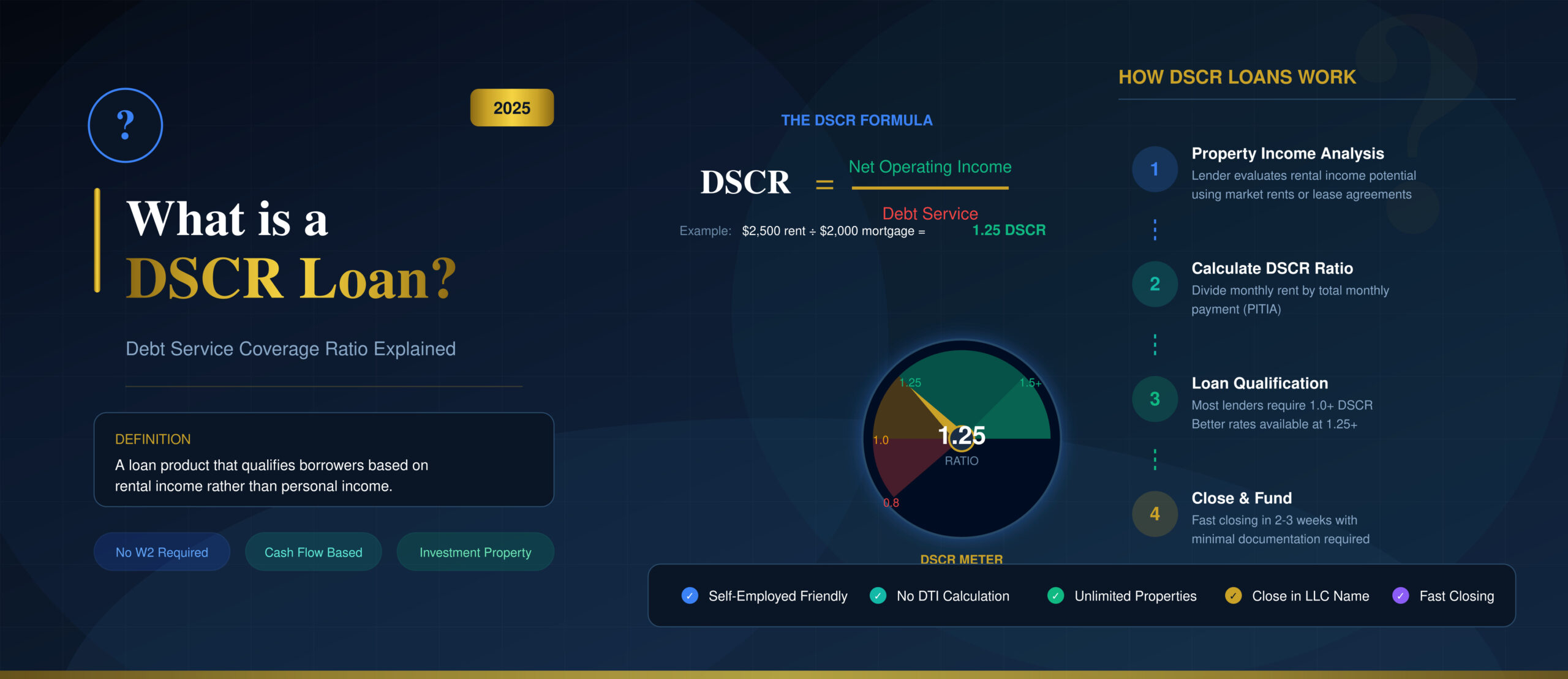
A DSCR loan is a type of investment property mortgage where approval is based primarily on the property’s cash flow rather than your personal income documents. DSCR stands for Debt Service Coverage Ratio—a calculation that measures whether your property generates enough rental income to comfortably cover its mortgage payments.
Unlike traditional mortgages that require extensive documentation of your salary, tax returns, and employment history, DSCR loans focus on the property’s financial performance. The lender wants to know: does this property generate sufficient rental income to pay for itself?
This fundamental difference makes DSCR loans particularly valuable for building or expanding rental property portfolios, self-employed investors with complex tax structures, commercial and multifamily properties, and investors with strong property cash flow but non-traditional income.
The key insight is this: DSCR loans shift the focus from “can you personally afford this mortgage?” to “does this property generate enough income to pay for itself?” This makes them powerful tools for real estate investors who understand property cash flow.
How Does a DSCR Loan Work?
Understanding how DSCR loans work helps demystify the process and shows why they’re structured differently from traditional mortgages.
The Underwriting Process
When you apply for a DSCR loan, the lender’s primary focus is evaluating the property’s income-generating ability. They examine actual rental income (if the property is already tenanted) or expected rental income based on market rent analysis. Using the rental income and proposed mortgage payment, the lender calculates the Debt Service Coverage Ratio to determine if the property generates enough cash flow to safely cover the debt service.
The lender also evaluates property type, location, and condition. Single-family rentals in strong markets typically qualify more easily than properties in weaker rental markets. They assess Loan-to-Value (LTV)—lower LTV generally means lower risk. While DSCR loans don’t require traditional income verification, lenders still consider your credit score, experience as an investor, and overall financial stability.
Loan Structure Options
DSCR loans come in various structures depending on the lender and your needs. Fixed-rate terms provide payment stability over 15-30 years, making cash flow projections straightforward. Adjustable or variable rates often start with lower initial rates that adjust periodically, working well if you plan to refinance or sell within a few years.
Interest-only periods allow you to pay only interest for an initial period (often 5-10 years), maximizing cash flow during property improvements or lease-up periods. Amortizing loans include principal and interest from the start, building equity steadily throughout the loan term.
DSCR loans can finance both purchases of new investment properties and refinances of properties you already own.
Understanding DSCR: How It’s Calculated
The heart of a DSCR loan is the calculation itself. Understanding this math helps you evaluate whether your property qualifies.
The DSCR Formula
DSCR = Net Operating Income (NOI) ÷ Annual Debt Service
Net Operating Income (NOI) is your property’s gross rental income minus operating expenses. Start with the total annual rent the property generates. From this, subtract all operating expenses including property taxes, insurance, maintenance and repairs, property management fees, HOA fees, utilities you pay, and any other recurring costs. Importantly, do not include your mortgage payment in operating expenses.
Annual Debt Service is simply your total yearly mortgage payment, including both principal and interest.
Worked Example
Let’s say you’re purchasing a rental property with these numbers:
- Annual gross rental income: £30,000
- Annual operating expenses: £9,000 (taxes, insurance, maintenance, management, etc.)
- Annual debt service: £20,000
First, calculate NOI: £30,000 – £9,000 = £21,000 NOI
Then calculate DSCR: £21,000 ÷ £20,000 = 1.05 DSCR
This means your property generates 105% of what’s needed to cover the debt service. While this meets the minimum threshold for some lenders, most prefer to see higher ratios.
What Is a Good DSCR for a Loan?
Understanding what constitutes a good DSCR helps you target properties that will qualify for financing—and potentially secure better terms.
Below 1.0: Your property doesn’t generate enough income to cover its own debt service. Very few DSCR lenders will finance these properties.
1.0-1.15: Borderline zone. Some lenders will approve loans with DSCR as low as 1.0, but there’s no cushion for vacancies or unexpected repairs. Expect higher interest rates.
1.15-1.25: Acceptable to most DSCR lenders for standard approval, though you may not see the most competitive pricing.
1.25-1.40: The sweet spot for competitive rates and favorable terms. Most lenders view DSCR in this range as healthy cash flow with adequate margin.
1.40 and higher: Excellent position. You’ll likely qualify for the best available rates and may have more negotiating leverage with lenders.
Who Qualifies for a DSCR Loan?
DSCR loans are designed for property investors and landlords, but understanding the typical borrower profile helps you assess whether this financing option makes sense for you.
Ideal Candidates for DSCR Loans
Portfolio landlords and experienced investors who own multiple rental properties find DSCR loans particularly valuable. Traditional lenders often limit you to 4-10 mortgaged properties, while DSCR lenders typically don’t impose these restrictions.
Self-employed investors and business owners whose income structure doesn’t fit traditional mortgage criteria benefit significantly. If your tax returns show lower income due to legitimate business deductions, DSCR loans evaluate the property’s performance rather than your personal income documentation.
Investors purchasing commercial or multifamily properties naturally fit the DSCR model since these properties are income-producing assets. Investors with strong property performance but complex personal finances—such as retirees living on investment income—also benefit.
Common Eligibility Requirements
While specific criteria vary by lender, most DSCR loans require a minimum DSCR of 1.0 to 1.25, credit scores of at least 660 (with better rates above 720), and down payments of 20-25% for single-family rentals. The property must be income-producing or intended for rental use. Many lenders require cash reserves (typically 6-12 months of mortgage payments).
Because eligibility criteria vary significantly between lenders, working with a specialist broker like McGowan Mortgages can help you identify which lenders are most likely to approve your specific situation.
DSCR Loan Rates: How Are They Determined?
Understanding how lenders price DSCR loans helps you position yourself for the best possible terms. Your DSCR level is the primary driver—higher DSCR indicates lower risk, potentially qualifying you for better rates. Loan-to-Value ratio significantly impacts rates, with lower LTV reducing lender risk.
Your credit profile and experience matter even though income verification isn’t required. Strong credit (720+) and demonstrated success as a property investor can improve your rate. Property characteristics influence pricing—single-family rentals in strong markets typically receive better rates. Market conditions affect DSCR loan rates just like any mortgage product.
DSCR loan rates typically run 0.5% to 1.5% higher than conventional owner-occupied mortgage rates, reflecting the flexibility and different risk profile. However, they’re often competitive with other investment property loan options.
Why Choose a DSCR Loan for Rental Property Financing?
DSCR loans offer compelling benefits for real estate investors. Approval is based on property performance, not personal income—the fundamental advantage. You can qualify based on the rental property’s cash flow rather than documenting complex personal income.
There are no DTI (debt-to-income) restrictions. Traditional mortgages factor your existing debts into affordability calculations, limiting borrowing capacity. DSCR loans don’t impose personal DTI limits, allowing portfolio growth based on property performance.
Portfolio scalability is significant. Many conventional lenders cap financed properties at 4-10. DSCR lenders typically don’t impose these limits, enabling unlimited portfolio growth as long as each property meets DSCR requirements.
Flexible structures are available depending on the lender. DSCR loans can offer interest-only periods, longer terms, or other features that traditional mortgages don’t provide. The qualification process is often faster without extensive income documentation requirements.
How DSCR Loans Compare to Traditional Mortgages
Conventional investment property mortgages may offer lower rates for investors who easily qualify. They require full income and employment documentation, strict debt-to-income ratio compliance, and have limits on the number of financed properties.
DSCR loans shine when you’re scaling beyond what traditional lending allows, when your income structure is complex, or when the property’s strong cash flow can carry the financing even if your personal income documentation is challenging.
Downsides and Risks of DSCR Loans
A balanced view requires acknowledging potential drawbacks. DSCR loans typically carry rate premiums of 0.5-1.5% compared to conventional mortgages. Over a 30-year term, this adds up.
Some lenders include ongoing DSCR covenants. If your rental income drops or expenses rise significantly, you might struggle to refinance. This makes property management and maintaining strong occupancy rates critical.
While some DSCR lenders offer 80% LTV, many require 25-30% down, tying up more capital. Some DSCR loan products include prepayment penalties or lock-in periods. Fewer lenders offer DSCR loans compared to conventional mortgages, making shopping for the best rate more challenging without a broker.
When Does a DSCR Loan Make Sense for Your Strategy?
DSCR loans typically make the most sense when you’re building a substantial rental portfolio—if you plan to own 5, 10, or 20+ properties, DSCR loans remove conventional lender restrictions. They’re ideal if you’re self-employed with complex income, purchasing multifamily or commercial properties, or if your investment strategy focuses on cash flow properties.
Traditional financing might be better if you’re buying your first rental property with straightforward W-2 income, if the property’s DSCR is borderline (below 1.2), or if you prioritize the lowest possible rate above convenience.
Every investor’s situation is unique. Consider discussing your specific goals with a specialist broker to determine the best approach for your circumstances.
How McGowan Mortgages Can Help with DSCR Loans
McGowan Mortgages specializes in investment property financing and can assess your property’s DSCR, evaluate your borrower profile, and advise whether DSCR financing makes sense. They provide access to multiple DSCR lenders with different appetites, specialties, and pricing, along with market knowledge about which lenders currently offer the most competitive terms.
Explore the learning center for more insights on investment property financing, or contact McGowan Mortgages to discuss your specific needs.
Frequently Asked Questions About DSCR Loans
What exactly does DSCR mean in property investing?
DSCR stands for Debt Service Coverage Ratio. It measures whether your property generates enough rental income to cover its mortgage payments by dividing your Net Operating Income by your Annual Debt Service. A DSCR of 1.25 means your property’s income is 125% of what’s needed for the mortgage, providing a 25% cushion for vacancies and repairs. Learn more about DSCR loans and how they work.
What DSCR do I need to qualify for a DSCR loan?
Most lenders require a minimum DSCR between 1.0 and 1.25, though requirements vary by lender and property type. For competitive rates and favorable terms, aim for DSCR of 1.25 or higher. Properties with DSCR of 1.4 or above typically qualify for the best available pricing. Check current mortgage rates and trends to understand the market.
Are DSCR loans more expensive than traditional mortgages?
Yes, DSCR loan rates typically run 0.5% to 1.5% higher than conventional owner-occupied mortgages, reflecting the flexibility and simplified qualification process. However, they’re often competitive with other investment property financing options like portfolio loans or commercial mortgages. Compare with conventional loan options to see which works best for your situation.
Can I use a DSCR loan for multiple rental properties or just one?
You can absolutely use DSCR loans for multiple properties—this is one of their biggest advantages. Each property is typically evaluated on its own DSCR, so you can continue financing additional properties as long as each meets lender requirements. Unlike traditional mortgages that often cap you at 4-10 financed properties, DSCR lenders typically don’t impose portfolio size restrictions. Explore more about investment property loans for portfolio growth.
How can a broker like McGowan Mortgages help me decide if a DSCR loan is right for me?
A specialist broker like McGowan Mortgages can calculate your property’s DSCR, evaluate your investment strategy, and compare DSCR options against traditional financing to determine which offers better terms. They access multiple lenders simultaneously and understand which are most likely to approve your specific scenario at competitive rates. Contact McGowan Mortgages to discuss your situation, or check the FAQs for more common questions.
Can I refinance my existing rental properties with DSCR loans?
Yes, DSCR loans work for both purchases and refinances, including cash-out refinancing to pull equity from existing properties. DSCR refinancing allows you to access equity without income documentation headaches. You might also consider HELOCs and home equity loans as alternative equity access strategies.
Do DSCR loans work for short-term rentals or only long-term tenancies?
This varies by lender—traditional DSCR loans are designed around long-term rental income (12-month leases). Some specialized lenders now offer DSCR loans for short-term rentals, but typically require 12-24 months of rental history and higher DSCR minimums (1.3-1.5). Visit the learning center for more guidance on different property types.
Can I use a DSCR loan if I’m a first-time investor with no rental property experience?
Yes, though first-time investors may face more stringent requirements like higher credit scores (720+), larger down payments, and properties with stronger DSCR (1.3+). Some lenders specifically cater to newer investors, and having solid market research and pre-lined-up property management strengthens your application. Check out our guide on buying a home for foundational knowledge, then contact us to discuss your first investment property.
Curious whether a DSCR loan fits your investment strategy? Contact McGowan Mortgages today for a personalized assessment. Our team specializes in investment property financing and can help you understand your options, calculate your DSCR, and find suitable lenders for your portfolio goals.
Do you know how much home you can afford?
Most people don’t... Find out in 10 minutes.
Today's Mortgage Rates